Loading...
Searching...
No Matches
lmic.c File Reference
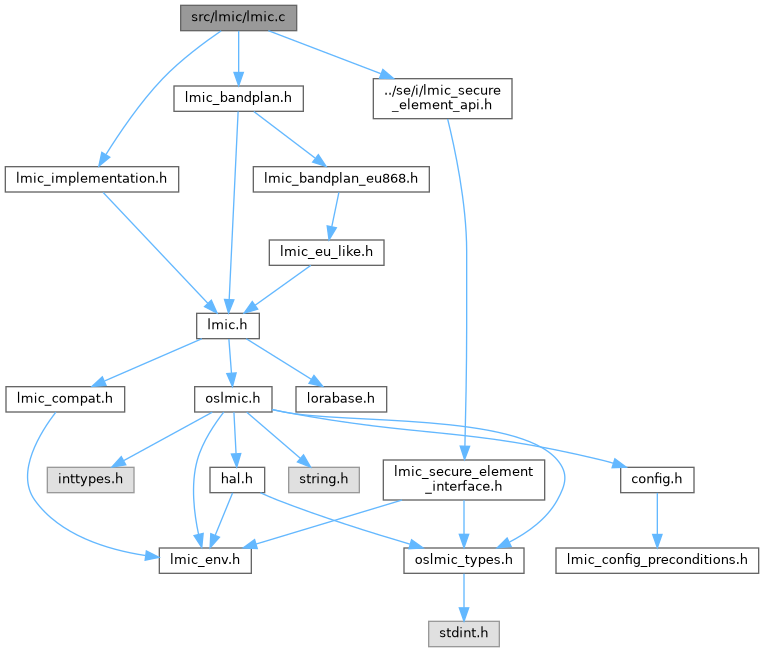
#include "lmic_bandplan.h"#include "lmic_implementation.h"#include "../se/i/lmic_secure_element_api.h"Include dependency graph for lmic.c:
Functions | |
| u1_t | LMIC_getBatteryLevel (void) |
| get battery level that is to be returned by DevStatusAns. | |
| bit_t | LMIC_queryTxReady (void) |
| check whether the LMIC is ready for a transmit packet | |
| u1_t | LMIC_setBatteryLevel (u1_t uBattLevel) |
| set battery level to be returned by DevStatusAns. | |
| void | LMIC_setSession (u4_t netid, devaddr_t devaddr, xref2u1_t nwkKey, xref2u1_t artKey) |
| Set up keys for ABP. | |
| ostime_t | LMICcore_adjustForDrift (ostime_t delay, ostime_t hsym, rxsyms_t rxsyms_in) |
| Adjust the delay (in ticks) of the target window-open time from nominal. | |
| u2_t | os_rlsbf2 (xref2cu1_t buf) |
| Read 16-bit quantity from given pointer in little endian byte order. | |
| u4_t | os_rlsbf4 (xref2cu1_t buf) |
| Read 32-bit quantity from given pointer in little endian byte order. | |
| uint64_t | os_rlsbf8 (xref2cu1_t buf) |
| Read 64-bit quantity from given pointer in little endian byte order. | |
| u4_t | os_rmsbf4 (xref2cu1_t buf) |
| Read 32-bit quantity from given pointer in big endian byte order. | |
| void | os_wlsbf2 (xref2u1_t buf, u2_t v) |
| Write 16-bit quantity into buffer in little endian byte order. | |
| void | os_wlsbf4 (xref2u1_t buf, u4_t v) |
| Write 32-bit quantity into buffer in little endian byte order. | |
| void | os_wlsbf8 (xref2u1_t buf, uint64_t v) |
| Write 64-bit quantity into buffer in little endian byte order. | |
| void | os_wmsbf4 (xref2u1_t buf, u4_t v) |
| Write 32-bit quantity into buffer in big endian byte order. | |
Function Documentation
◆ LMIC_getBatteryLevel()
| u1_t LMIC_getBatteryLevel | ( | void | ) |
get battery level that is to be returned by DevStatusAns.
- Returns
- This function returns the saved value of the battery level (as used for the DevStatusAns message).
- See also
- LMIC_setBatteryLevel()
References LMIC_getBatteryLevel().
Referenced by LMIC_getBatteryLevel(), and LMIC_queryChannel().
◆ LMIC_setBatteryLevel()
| u1_t LMIC_setBatteryLevel | ( | u1_t | uBattLevel | ) |
set battery level to be returned by DevStatusAns.
- Parameters
-
uBattLevel is the 8-bit value to be returned. Per LoRaWAN 1.0.3 line 769, this is MCMD_DEVS_EXT_POWER(0) if on external power,MCMD_DEVS_NOINFO(255) if not able to measure battery level, or a value in [MCMD_DEVS_BATT_MIN,MCMD_DEVS_BATT_MAX], numerically [1, 254], to represent the charge state of the battery. Note that this is not millivolts.
- Returns
- This function returns the previous value of the battery level.
The LMIC maintains an idea of the current battery state, initially set to MCMD_DEVS_NOINFO after the call to LMIC_init(). The appplication then calls this function from time to time to update the battery level.
It is possible (in non-Arduino environments) to supply a local implementation of os_getBatteryLevel(). In that case, it's up to the implementation to decide whether to use the value supplied by this API.
This implementation was chosen to minimize the risk of a battery measurement introducting breaking delays into the LMIC.
References LMIC_setBatteryLevel().
Referenced by LMIC_queryChannel(), and LMIC_setBatteryLevel().
◆ LMIC_setSession()
| void LMIC_setSession | ( | u4_t | netid, |
| devaddr_t | devaddr, | ||
| xref2u1_t | nwkKey, | ||
| xref2u1_t | artKey ) |
Set up keys for ABP.
The LMIC stores the given session keys and put thes MAC in a state as if a join request/accept had just negotiated these keys.
- Parameters
-
netid a 24-bit number describing the network id this device is using devaddr the 32-bit session address of the device. It is strongly recommended to ensure that different devices use different numbers with high probability. nwkKey the 16-byte network session key used for message integrity. If NULL the caller has copied the key into LMIC.nwkKey before. artKey the 16-byte application router session key used for message confidentiality. If NULL the caller has copied the key into LMIC.artKey before.
- Note
- On Harvard architectures, if session keys are in flash and not accessible via normal C pointers, caller must fill in LMIC.{nwk,art}Key separately and pass {nwk,art}Key as NULL.
- It is crucial that the combinations devaddr/nwkkey and devaddr/artkey are unique within the network identified by netid.
References LMIC_SecureElement_Aes128Key_s::bytes, LMIC_SecureElement_KeySelector_Unicast, LMIC_setSession(), OP_JOINING, OP_NEXTCHNL, OP_PINGINI, OP_REJOIN, OP_TRACK, OP_TXRXPEND, OP_UNJOIN, and os_copyMem.
Referenced by LMIC_queryChannel(), and LMIC_setSession().
◆ LMICcore_adjustForDrift()
| ostime_t LMICcore_adjustForDrift | ( | ostime_t | delay, |
| ostime_t | hsym, | ||
| rxsyms_t | rxsyms_in ) |
Adjust the delay (in ticks) of the target window-open time from nominal.
- Parameters
-
hsym the duration of one-half symbol in osticks. rxsyms_in the nominal window length – minimum length of time to delay.
- Returns
- Effective delay to use (positive for later, negative for earlier).
- Postcondition
- LMIC.rxsyms is set to the number of rxsymbols to be used for preamble timeout.
- Bug
- For FSK, the radio driver ignores LMIC.rxsysms, and uses a fixed value of 4080 bits (81 ms)
The calculation of the RX Window opening time has to balance several things. The system clock might be inaccurate. Generally, the LMIC assumes that the timebase is accurage to 100 ppm, or 0.01%. 0.01% of a 6 second window is 600 microseconds. For LoRa, the fastest data rates of interest is SF7 (1024 us/symbol); with an 8-byte preamble, the shortest preamble is 8.092ms long. If using FSK, the symbol rate is 20 microseconds, but the preamble is 8*5 bits long, so the preamble is 800 microseconds. Unless LMIC_ENABLE_arbitrary_clock_error is true, we fold clock errors of > 0.4% back to 0.4%.
References LMIC_kMaxClockError_ppm, LMICcore_adjustForDrift(), and MAX_CLOCK_ERROR.
Referenced by LMICcore_adjustForDrift().